
Most agencies start with the founder involved in almost everything. They are on the client calls, they review the deliverables before they go out, and they are the person everyone asks when they are not sure how to do something. At that stage this works well, as one person can keep an eye on quality and make sure every client gets the same standard of work.
As the agency grows, this model becomes harder to maintain. More people join, accounts move from one person to another, and the way a task gets done starts to depend on who is doing it. In many cases the knowledge that keeps the agency running is still in the heads of a few senior people, who end up spending a big part of their week answering questions and checking work instead of focusing on clients and growth.
In this article we look at how to move your agency operations from people's heads into documented systems that the team can actually use. We already covered the basics of writing SOPs and mapping workflows in our guide to process documentation, so here the focus is on agencies specifically: which agency processes to systemize first depending on your size, which parts of the client lifecycle are usually left undocumented, how to keep space for creative work, and how to measure if it's working.
Why agency operations get harder as you grow
Every business gets more complex as it grows, but agencies have a few characteristics that make this more noticeable. Most of the work is at least partly customized for each client, a single deliverable often goes through several people before it reaches the client (strategy, execution, review, account management), and every client has different expectations on communication and results. Each of these steps is a point where information can get lost or misunderstood.
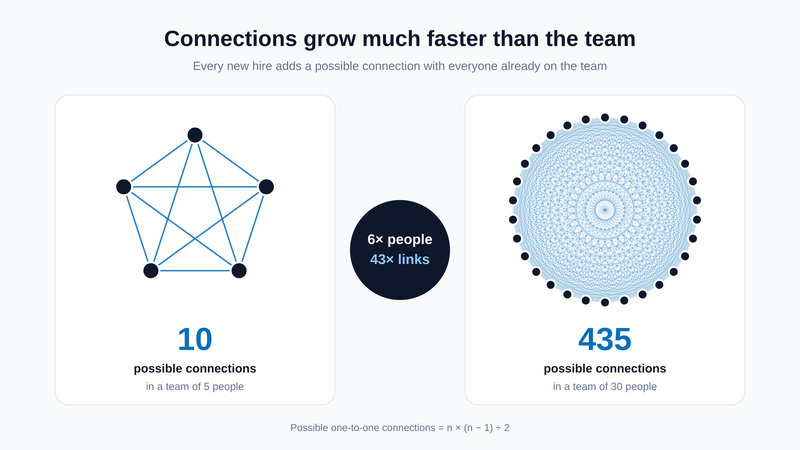
The number of connections between people also grows much faster than the team itself. In a team of 5 people there are 10 possible one-to-one connections, while in a team of 30 there are 435. Not all of them are active, but this explains why an agency that worked smoothly with 8 people can feel chaotic at 25, even if everyone is doing a good job. Coordinating through quick questions and Slack messages works up to a certain size, and after that it starts creating delays and mistakes.
The second change is about the role of the founder or the senior team. In a small agency, consistency usually comes from one experienced person checking everything. When the volume of work increases, that person becomes a bottleneck and the agency develops a key person dependency that limits how many clients it can take on. Many discussions about how to scale a marketing agency focus on sales and hiring, but in my experience the real limit is more often in delivery. You can only grow as fast as your operations can handle the extra work without the quality dropping.
Start by asking what would break if you doubled your clients
Before writing any SOP, it helps to understand where the weak points are. A question that works well is to ask the leadership team: if we doubled our client portfolio tomorrow, what would break? Answering it forces them to look more closely at how things work today, with the goal of finding the steps that don't look like a weak point at the current scale but could become a big bottleneck in the next phase of growth.
To make the exercise practical, go through your main workflow one stage at a time and, for each step, ask who does it today, how long it takes, what they need from someone else before they can start, and what would happen if the volume doubled. Steps that depend on one person remembering to do something, or on a senior person finding time to review work in an already full week, usually come up very quickly.
Tip: if the answer to "how does this get done?" is the name of a person instead of a process, that step is a good candidate for documentation.
In most cases the core work holds up well in this exercise. The problems tend to be in what happens around it, such as approvals, reporting, onboarding, handovers between teams and account managers who already have too many clients. These are the areas where your first agency systems should go. If you want a more structured method to find them, our article on bottleneck analysis explains it in detail.
What to systemize first, depending on your agency's size
Trying to document everything at once usually ends with a lot of half-finished documents, so it's better to prioritize. The right starting point depends a lot on the size of the agency, as the problems of a 6-person team are very different from the ones of a 60-person agency. The table below is based on the patterns we see most often.
| Agency size | What usually starts to break | Where to focus first |
|---|---|---|
| 1–10 people | Quality depends on the founder reviewing everything, and the founder can't step away | Client onboarding checklist, SOPs for your two or three core deliverables, a standard reporting template |
| 10–30 people | Output varies from one team member to another, and new hires take months to become independent | Quality control checkpoints, an employee onboarding path, client communication standards |
| 30–60 people | Handoffs between departments slip, and scope and capacity become hard to track | Cross-team workflows, a scope change process, an account handover procedure, escalation paths |
| 60+ people | Different teams or squads develop their own version of the same process | Process owners, regular reviews, version control, internal training on the standard |
How the agency is paid also changes what you should focus on. A retainer agency (SEO, PPC, social media, content) works on a monthly cycle of planning, execution, reporting and a review call, repeated for every client. Since the same steps run dozens of times a month, documenting this cycle gives the biggest return. A project-based agency (websites, branding, campaigns) works on longer one-off projects, so most of the value is in standardizing the phases of the project and the client sign-off between them, which is where delays and disagreements usually start.
Many agencies have both models, and that's fine. In that case it's better to document them as two separate workflows.
Map the full client lifecycle, not only the deliverables
When agencies start documenting, they usually begin with the deliverables: how to run a technical audit, how to set up a Google Ads campaign, how to brief a designer. This is understandable, as it's the work the team does every day. However, clients experience the agency as a whole journey, from the first sales call to the day the contract ends, and a lot of what they think about you is shaped outside the deliverables.
For this reason it's useful to map the whole journey and check which stages have a defined process and which ones depend on habits. For most agencies the agency workflow looks more or less like this:
| Stage | What can go wrong without a process | What to document |
|---|---|---|
| Sales to delivery handover | Things promised during the pitch never reach the delivery team | A handover brief with scope, goals, budget, contacts and anything agreed verbally |
| Client onboarding | Access requests take weeks and the first deliverable is late | Access checklist, kick-off call agenda, timeline to the first deliverable |
| Delivery | Different people approach the same task in different ways | SOPs for the core deliverables and the order they run in |
| Reporting and reviews | Reports vary in quality and are sent late | Report template, data checks, who reviews the report before it's sent |
| Renewal and growth | Renewal is only discussed when the contract is about to end | When account reviews happen and what they cover |
| Offboarding | Access stays open, files are scattered and the relationship ends badly | Access removal, handover of assets, final report |
Once the stages are mapped, the gaps are usually easy to see. A process map of your marketing agency workflow also shows the handoffs between people, which is important because handoffs are where work often sits waiting for someone who doesn't know it's their turn. In WorkFlawless, each step of a flowchart can be linked to the SOP that explains how to do it, so someone looking at the onboarding flow can open a step and see what's expected without searching through shared folders.
Three processes agencies often forget to document
Some processes don't happen every day, so they rarely make it to the documentation list. However, they are often the ones that create the most problems when they go wrong.
Scope changes
Scope creep rarely comes from one big request. More often it builds up with small extra requests that seem reasonable to accept during a call, until the team is delivering much more than what's in the contract and the margin on the account is gone. The process to manage this can be simple, as long as it defines who can approve work outside the scope, how the request is recorded and how the client is informed about the impact on cost or timelines. Having it documented also helps account managers, who otherwise have to decide on the spot between refusing the client and accepting something the team can't deliver.
Account handovers
Account managers change teams, go on leave or leave the agency, and the client always notices the change. A good handover includes more than the list of open tasks. It should cover the history of the account, the client's preferences, any sensitive points (for example a stakeholder who prefers a call to an email, or an issue that came up in the last review) and any commitment that was made by email and never recorded anywhere else. A standard handover template, together with a short period where both people work on the account, makes the transition much easier for the client and for the team.
Client offboarding
Every agency loses clients at some point, and the way the relationship ends has an impact on referrals and on the chance that the client comes back in the future. Offboarding should include removing your team's access from the client's platforms, handing over assets, accounts and reports in an organized way, and closing the account in your internal systems. It's also a good moment to have a short exit conversation, as clients who are leaving often share feedback they never mentioned before.
Finding the balance between systems and creative work
One of the most common concerns from agency teams is that documenting processes will make the work too rigid. This is understandable, especially for strategists and creatives who were hired for their judgment, and it should be discussed openly with the team instead of introducing new processes and expecting people to simply follow them.
A good SOP defines the inputs, the quality standard the output needs to meet and the checkpoints along the way, and leaves the creative approach to the person doing the work. For example, a content brief template makes sure the writer always knows the audience, the target keyword, the tone and the deadline. It doesn't tell them how to write the introduction, as that's the part you hired them for.
Tip: if two experienced people would complete the same task in different ways and both results are equally good, standardize the result and the quality checks, and leave the method to them. If different methods lead to different quality, document the method.
Keeping this distinction also makes the documentation easier to maintain. The more technical steps (setting up tracking, pulling data for reports, running a QA checklist before a launch) only change when tools or standards change, while creative work changes all the time and is very hard to describe step by step. If you're not sure which format to use for a task, our article on the difference between a work instruction and an SOP can help.
Rolling out the new processes with your team
Writing the documentation is usually the easier part. The harder part is getting a busy team to use it, and when this doesn't happen it's rarely because people are lazy. More often the documented process is harder to find than asking a colleague, it doesn't reflect how the work is actually done, or nobody checks if it's followed. We covered this in more detail in why your team still doesn't follow your processes, but there are a few things that make a big difference in agencies.
Involve the people who do the work
A senior SEO who has run 200 technical audits knows the details and the common mistakes much better than an operations manager who has never run one. The best approach is to give them a template and a deadline, let them write the first draft and then review it for clarity and missing steps. People are also more likely to follow a process they helped create.
Test it with one team first
If you introduce a new process to the whole agency at the same time, every problem in it will show up everywhere at once. Testing it for a month with one team or a few clients helps you find and fix the issues early, and the people who tested it can then help explain it to the rest of the agency.
Make the process easy to access
If someone has to stop what they're doing, open a shared drive and look through several folders to find an SOP, they will probably ask a colleague instead. This is one of the reasons we built WorkFlawless the way we did: steps can be assigned to people as tasks, new hires can follow a structured onboarding path, and with the Slack integration and the Chrome extension the right procedure is available from the tools the team already uses.
Assign an owner and review it regularly
Tools, client expectations and platform features change all the time (anyone who has managed Google Ads accounts in the last few years knows this very well), so a process that is written once and never updated becomes outdated quickly. Each process should have an owner and a review date, which for core processes is usually every three to six months. Our article on how often to review SOPs explains how to choose the right frequency.
How to know if it's working
Systemizing your operations takes time, so it's important to know if the effort is having an impact. The best way is to choose a few metrics before you start, record where you are today and check them again after a few months. These are the ones we find most useful in agencies:
| Metric | What it tells you | How to measure it |
|---|---|---|
| Time for new hires to work independently | Whether your documentation is good enough to train people without constant support | Weeks from the start date until the person manages their tasks or accounts without daily help |
| Revision rounds per deliverable | Whether the team understands the brief and the standard from the start | Average number of internal and client revisions before approval |
| Issues found internally vs by the client | Whether your quality checks catch problems early | Errors found in internal QA compared to the ones reported by clients |
| On-time delivery | Whether handoffs and capacity planning are working | Percentage of deliverables and reports sent by the agreed date |
| Repeated questions to the senior team | How much knowledge still depends on specific people | A rough count, over two weeks, of questions a document should have answered |
| Client retention | The long-term effect of more consistent delivery | Clients retained over 12 months |
You don't need to track all of them. Two or three that are connected to the problems you found when asking what would break are usually enough, and having the numbers makes it much easier to show the team and the leadership why the work is worth the time.
Final thoughts
Systemizing an agency is a gradual process, and it doesn't need to happen all at once. Most agencies get good results by starting with the few processes that cause the most problems today, documenting them together with the people who do the work and then building from there, one quarter at a time.
Scale always brings some chaos, and things can break where you least expect them. Identifying those points early means you can prevent them from failing, or be better prepared when they do. If you want to see how WorkFlawless can help you map your workflows and connect them to your SOPs in one place, you can try it free for 14 days.
