Every business runs on processes. Whether you're a 10-person agency or a 200-person company, there are sequences of tasks that need to happen in a specific order, by specific people, using specific tools, to produce the outcomes your business depends on. That much is obvious.
What's less obvious is how few companies actually capture those processes in a way that's useful. Most businesses either don't document their processes at all, or they create documentation that lives in a forgotten folder somewhere, quietly becoming outdated while the team keeps doing things the way they've always done them.
This guide is about closing that gap with a practical framework for building process documentation that becomes a real operational asset for your business.
What is process documentation?
Process documentation is the practice of recording how work gets done inside your organization. It captures the steps, decisions, responsibilities, and tools involved in completing a specific task or delivering a specific outcome, in a format that allows anyone with the right skills and access to understand and replicate that work consistently.
Depending on the nature of the process, this documentation can take different forms, for example a written SOP (Standard Operating Procedure), a visual workflow diagram, a checklist, or a combination of these. No matter what format is used, what's important is that the knowledge that currently lives in people's heads gets translated into something tangible, accessible, and usable by the wider team.
That last point is important, because this is where the conversation around process documentation tends to go sideways. Companies treat it as a writing exercise when it's really an operational infrastructure project. The output isn't a document. The output is a system that enables consistent execution, faster onboarding, better delegation, and scalable growth. The document is just the vehicle.
Why process documentation matters more than most businesses realize
If you're reading this, you probably already sense that your business would benefit from better documentation. But the scale of the problem often catches people off guard when they see the data.
The Panopto's Workplace Knowledge and Productivity Report found that knowledge workers waste an average of 5 hours per week either waiting for information from colleagues or recreating work that already exists somewhere in the organization. The same study found that "On average, employees reported spending nearly 6 hours each week “reinventing the wheel” and duplicating other people’s work. Almost 1 in 3 say they spend more than 6 redundant hours every week. For 14 percent, duplicative work takes up a minimum of 10 hours." (source: Panopto)
These aren't just big-company problems. In a small or mid-sized business, a single employee spending 5 hours per week searching for information that should be documented translates into roughly 260 lost hours per year. That's over six full work weeks per person. Multiply that by your team size and your average hourly cost, and it adds up fast.
But the cost of undocumented processes goes beyond lost hours. It creates what some call key person dependency: the situation where critical knowledge lives in just one or two people's heads, and the business becomes dangerously reliant on their availability. When that person goes on leave, gets sick, or decides to leave the company, you lose the knowledge of how a significant chunk of your operations actually works.
Then there's the growth dimension. Companies that try to scale without documented processes invariably hit the same wall: what worked when the team was five people falls apart at thirty. Things like informal handoffs becoming misunderstandings, verbal instructions becoming a game of telephone, quality starting to vary wildly depending on who's doing the work and many more issues will become apparent and underline an operational chaos that was invisible with a smaller team.
Process documentation is the antidote to all of this. When done properly, it preserves institutional knowledge, speeds up onboarding, standardizes quality, enables delegation, and gives you a real foundation for growth.
The different types of process documentation (and when to use each)
Not all process documentation looks the same, and using the wrong type for the wrong situation is one of the most common mistakes businesses make. Here's how the main types compare and when each one works best.
Standard Operating Procedures (SOPs)
SOPs are detailed, step-by-step instructions for completing a specific task. They're the most common form of process documentation, and for good reason: they're thorough, easy to follow, and they work well as both daily reference guides and training resources for new team members.
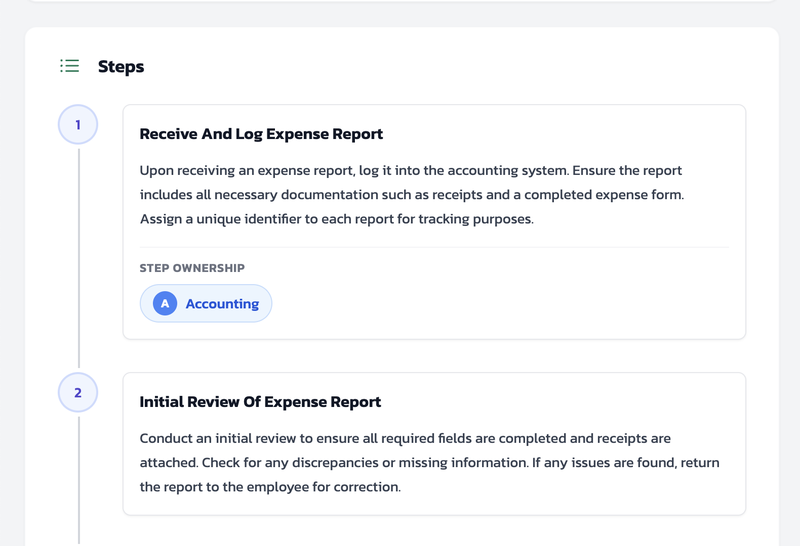
Best for: Tasks that require precision and consistency, where the steps need to be followed in a specific sequence. Think client onboarding, invoice processing, quality assurance checks, or any task where deviations from the standard approach could lead to errors. Our comprehensive guide to Standard Operating Procedures goes deeper into how to write effective SOPs.
Workflow diagrams and process maps
Workflow diagrams are visual representations of how a process flows from start to finish. They use shapes, arrows, and decision points to show the sequence of steps, who's responsible for each one, and what happens when the process branches based on different conditions. They make complex, multi-step processes understandable at a glance.
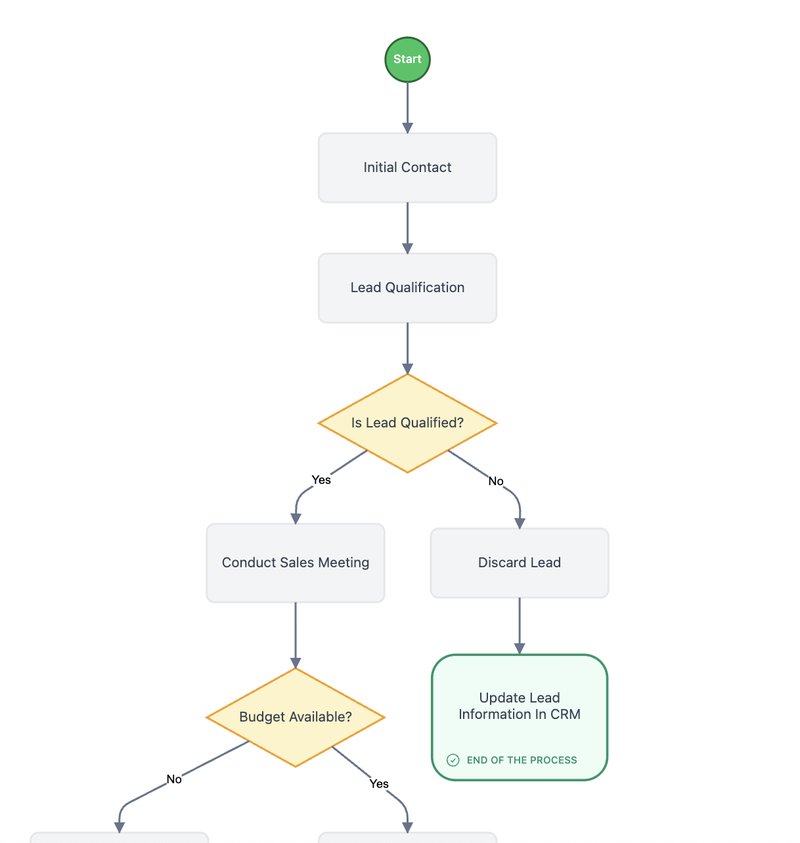
Best for: Processes with multiple decision points, branching paths, or handoffs between team members. Things like project delivery workflows, escalation procedures, approval processes, or any sequence where understanding the full picture matters. Check out our article on business workflow diagrams and flowcharts for a practical guide on creating these.
Checklists
Checklists are the simplest form of process documentation, and that simplicity is their superpower. They list the steps or criteria that need to be completed for a task, without necessarily prescribing a specific order. They're fast to create, easy to maintain, and extremely effective for ensuring nothing gets missed in routine operations.
Best for: Recurring tasks where completeness matters more than sequence. Things like pre-launch quality checks, weekly reporting tasks, new employee setup steps, or any process where the primary risk is forgetting a step rather than doing steps in the wrong order.
The layered approach: why connected documentation wins
Here's something that very few guides on process documentation mention: these different types of documentation work best when they're connected to each other, not when they exist as isolated files.
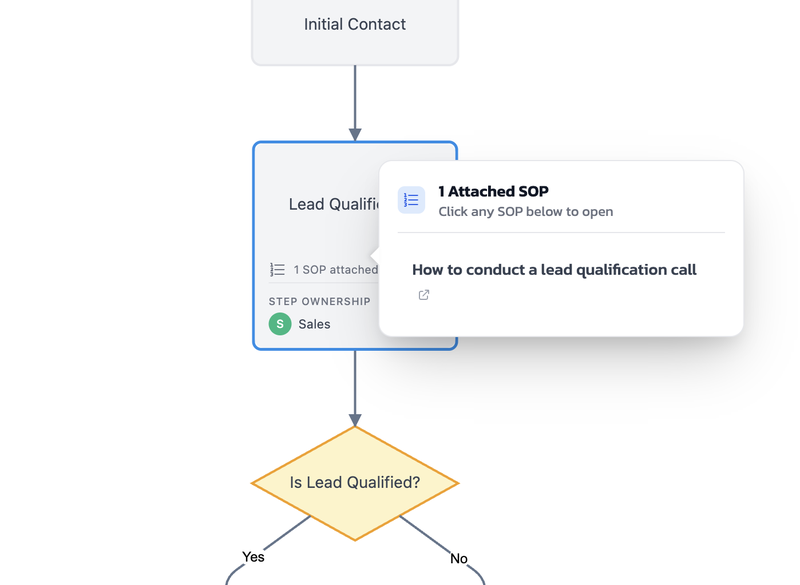
A workflow diagram shows someone the big picture of how a process flows and where the decision points are. But it doesn't tell them exactly how to perform each step. That's where SOPs come in. And a checklist can serve as a quick-reference companion to ensure nothing gets skipped.
When these layers are connected, someone can zoom in and out depending on what they need. A new team member starts with the visual workflow to understand the overall process, then drills down into the SOP for each step they're responsible for. An experienced team member might just need the checklist.
This layered, connected approach is something we built WorkFlawless around. The platform lets you create visual workflow diagrams and link detailed SOPs directly to individual steps, so your documentation works as an integrated system rather than a collection of disconnected files scattered across Google Drive, SharePoint, and email threads.
How to create process documentation that actually gets used
Creating documentation isn't the hard part. Creating documentation that people actually reference and rely on is. Here's a practical framework that addresses the most common points of failure.
Start with the processes that matter most
Trying to document everything at once is one of the fastest ways to burn out and abandon the whole effort. Instead, identify the 10 to 15 processes that have the biggest impact on your operations. These are usually the ones that get repeated most often, involve multiple people, directly affect your customers, or where mistakes are the most costly.
Think about your client onboarding flow, your project delivery process, your hiring workflow, your financial close procedures, your sales process, and your quality control checks. These are the processes where good documentation will deliver the highest return on your time investment. Start with these, build momentum, and expand from there.
Talk to the people who actually do the work
One of the biggest mistakes you can make is documenting processes based on how you think things work. The people who execute a process every day know the nuances, the edge cases, the shortcuts, and the pain points that aren't visible from the outside. Sit down with them. Have them walk you through exactly what they do, step by step. Ask where things tend to go wrong and what information they wish they'd had when they started.
This is also about buy-in. When the people who do the work are involved in documenting it, they're far more likely to actually use and maintain that documentation going forward. Processes that get written in isolation by management and pushed down to the team rarely survive first contact with the real world.
Write for the person who doesn't know how to do this yet
When you're documenting a process, always write as if the reader has never done it before. It's tempting to skip steps or use shorthand when you know a process well, but that defeats the entire purpose. The documentation should enable someone with the right baseline skills and access to follow the process independently, without needing to interrupt a colleague for clarification.
That means including the tools required, the access and permissions needed, what a successful outcome looks like, what to do when something goes wrong, and context about why a step matters (not just what to do). Add screenshots, images, or videos wherever they help illustrate something that's hard to convey in text alone.
Choose the right format for each process
Match the format to the nature of the work, as covered earlier: visual workflows for complex multi-step processes, SOPs for tasks requiring step-by-step precision, and checklists for simple recurring tasks. Wherever possible, connect these formats together so your team gets the big picture and the granular detail in one navigable system.
Assign ownership and schedule reviews
Every documented process needs a clear owner: someone accountable for keeping it accurate and current. Without ownership, documentation drifts from reality within months. Steps change, tools get updated, roles shift, and the document stays frozen in the past. Eventually the team stops trusting it and stops using it.
Set a review cadence that matches the pace of change. Rapidly evolving processes might need monthly reviews; stable ones might only need quarterly attention. We've written about how often SOPs should be reviewed if you want practical guidance on building a sustainable review schedule.
Make the documentation easy to find
This sounds basic, but it's one of the most common reasons process documentation goes unused. If people can't find the document they need within seconds, they'll default to asking a colleague or figuring it out on their own, which brings you right back to the knowledge-sharing problems you were trying to solve.
Your process documentation should live in a single, centralized, searchable location. Not spread across Google Docs, SharePoint, Notion, and email threads. One place, organized by team or function, with search that lets anyone find what they need instantly.
Process documentation as a growth enabler
There's a pattern that repeats in nearly every growing company. Things work fine when the team is small, because everyone knows each other, communication is informal, and knowledge gets shared organically through daily interaction. But as the company grows and new people join who weren't there when the original decisions were made, that informal system starts breaking down. Different team members develop their own versions of the same process.
Process documentation is what breaks this cycle. When your processes are documented, new team members ramp up faster because they have a clear reference for how things work. Quality stays consistent because everyone follows the same documented approach. And when processes need to evolve, you have a clear baseline to improve from instead of trying to redesign something that was never properly designed in the first place.
This becomes even more important when the business approaches significant milestones. Whether you're expanding into new markets, preparing for investment, or positioning for acquisition, documented processes signal operational maturity. Buyers and investors consistently look for businesses that can operate reliably without depending on specific individuals. A company that can clearly demonstrate how its operations work is a fundamentally more valuable proposition than one running on tribal knowledge and ad-hoc practices.
Getting started: what to do this week
Pick the one process that would hurt the most if the person who runs it was suddenly unavailable. That's your first documentation priority. Sit down with the person who owns that process. Have them walk you through it. Capture the steps, the decisions, the tools, and the common exceptions. Turn it into a visual workflow to show the overall flow, and write an SOP for any step that's complex enough to warrant detailed instructions.
Don't aim for perfection on the first pass. Aim for accuracy and completeness. You can refine the formatting and polish later. What matters right now is getting that critical knowledge out of someone's head and into a system that the rest of the team can access, follow, and rely on.
From there, build the habit. Document the next most critical process, then the one after that. Assign owners. Set review dates. The companies that treat process documentation as ongoing operational infrastructure, not a one-off project, are the ones that scale without losing what made them good in the first place. It's not the most glamorous work. But it's the kind that compounds quietly and pays dividends long after the initial effort.

